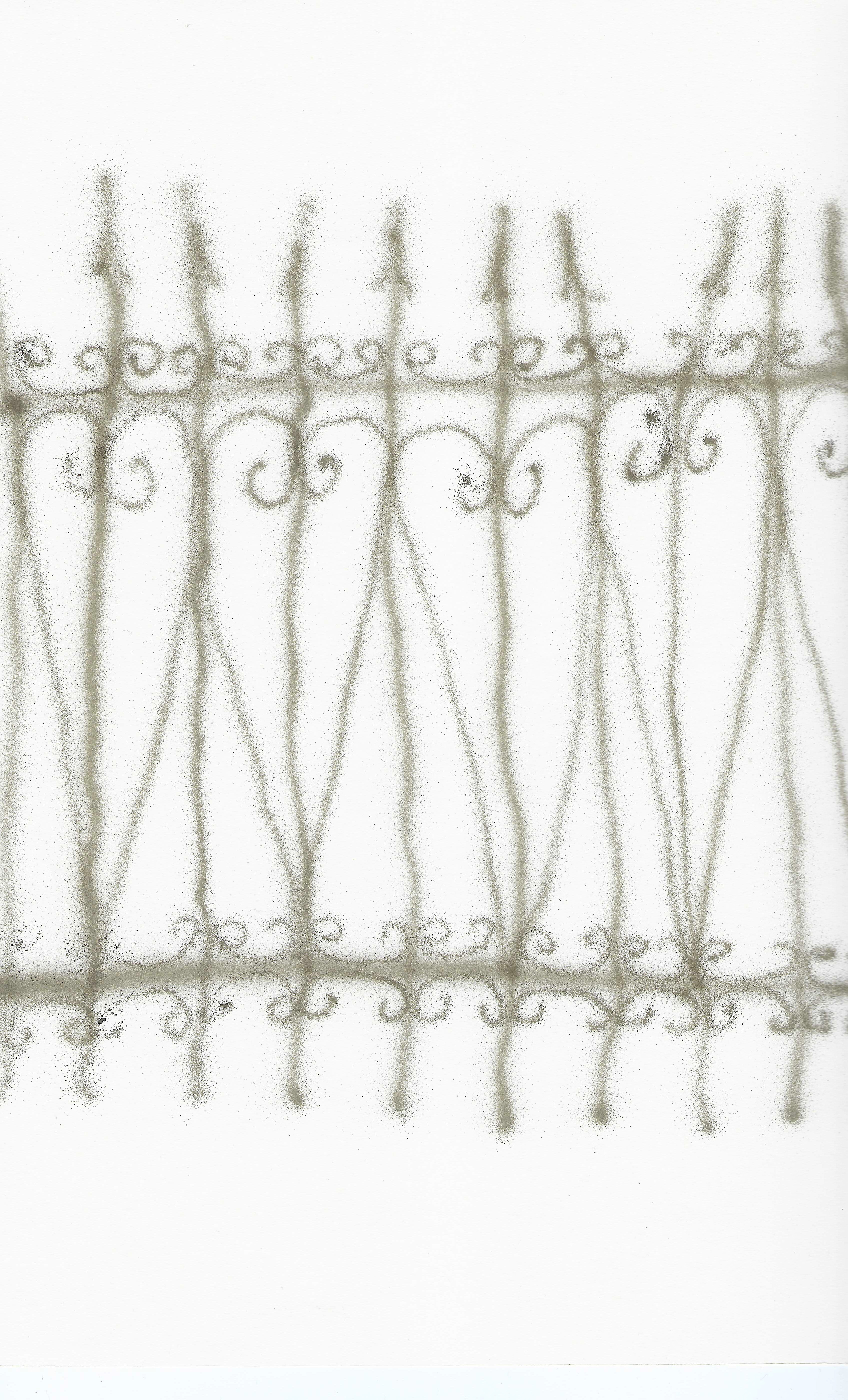

In her artist practice, Tabata von der Locht expands her working environment from the studio to urban areas. By walking around and observing, she develops an ever-growing collection of traces, imprints and fragments. This collection consistsof small and easily overlooked details as stains of chewing gum ontarmac or remnants of posters on advertising columns. Further observations document graffiti, markings on construction sites and thestructure of fences or pigeon deterrent systems. In this way, gesturesand traces that belong to a wide range of people are brought together. Tabata developed an own method for removing color pigments. Thisallows her to actually transfer the marks left by society into her artistic practice, instead of only having the possibility to imitate andtranslate them. She then takes the collected traces to the studio toprocess them further. The concept of putting urban finds into a new context constitutes Tabata’s serial approach referencing different materialities. Thus,the interplay between collecting and translating can be discovered inher fabric collages, sculptures, and photographs. Her focus on drawing gestures from urban space is accompanied byan investigation of forms and structures of defense systems. These observations from cityscape convey an impression of protection andexclusion, defensiveness and vulnerability. Tabata starts her work process by walking around and observingfamiliar and new urban surroundings. In doing so, she recognizesthe surfaces of the city as carriers of their own stories. By using her self-developed solvent, the color pigments and structures of buildingfacades, markings or signs are removed and remain on the appliedfabric. Later in the studio, the fabric fragments are sorted, combinedand sewn together. In some cases, they are complemented by transparent layers of fabric, airbrushing, spray, or painterly gestures. With Tabata’s work on marks and traces, a relationship between atrace’s originator, the artist and viewers develops. The use of otherpeople‘s traces raises questions about authorship and appropriation.At the same time, it creates a special closeness to an unknown person. The trace found in public space indicates the presence of an unknown person at this exact location, at an earlier point in time. The discovery of this particular trace in this particular place marks anindirect meeting between Tabata and its originator, separated onlyby time. By transferring the found trace to the exhibition space, itbears witness to this encounter and thus enables viewers to see thatfind in a new place and context, at a later date. In this way, Tabata transfers the stories she has discovered outsideinto new spaces that question the conception of painting. Her worksform an interface between exterior and interior spaces: not only dothey convey the imprints created on site, but they can also be seen asa document of a memory, as an imprint in a broader sense.
Johanna Disch